The launch of the Canon EOS 20D in August 2004 took the world by storm quite literary. With 8.2 megapixels and a superior DIGIC II CMOS sensor means photographers can enjoy superb low light performance and exceptionally low noise images, even at ISO 1600. In this article, Canon USA states “The EOS 20D digital SLR can be used as a backup camera for the high-performance EOS-1D Mark II digital SLR,” I beg to differ. In fact, I found the 20D so unbelievably good that it went from a backup for my 1D MkII to replacing it as my favourite body for professional work. In case that didn’t register, I sold the 1D MkII and kept the 20D and Canon Singapore folks were understandably puzzled when I told them this.

But there’s more … the popularity of the 20D quickly became a media attention when bodies fitted with the optional BG-E2 Battery Grip started showing an anomaly. An anomaly that, as far as I’m concerned, began with the EOS 300D. Problems surfaced when users reported premature and unusual Battery Low, a phenomenon that plagued me more times than I cared to remember and the awkward situation I found myself in several times during a critical assignment.
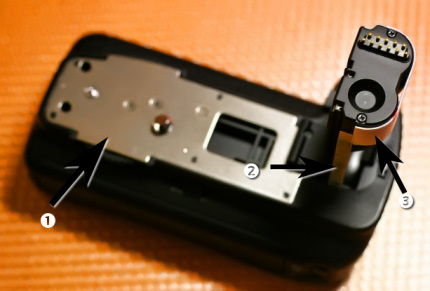
I put up with this intermittently occurring phenomenon for sometime. There seemed to be a couple of recommended fixes prescribed by Canon, one of which required several washers to be placed at corners of (1) above under the factory face plate. A second fix involved ‘fixing’ the camera voltage that may have fluctuated outside the normal operating range/tolerance. Guess what? they did not work, at least for me, the problem came back with renewed vengeance and it started occuring more frequently than before. After an official fix didn’t work, I researched on the web for ideas and eventually led to what I believe to have permanently fixed the problem.
Identifying the source of the problem is as critical as fixing it. It seemed that the problems stemmed from what was known as flexing of the grip. I’ve never owned a 10D nor have I ever held one with a grip fitted but it’s been widely reported that the 20D’s grip was flimsy and cheap at best. No argument there.
Now, take a look at the picture numbered above. I found a lot of play at locations (2) and (3). After I had padded the affected areas, the grip became solid and no longer wobbly when pressured is applied. Then I picked up another idea from a forum poster. Instead of fitting washers under the black top of the grip, I took it off and doing so increased the depth on which the body can be tightened. The combined fixes gave me a very firm and usable product!

But that’s not all. I have two sets of batteries, a pair of original BP-511A 1390mAh and another pair of OEM (Camera Devices) 1800mAh that have worked well for me. The thing to note here is the terminals on the OEM ones have a tendency for built-up that may or may not compromise conductivity. But I find it’s good practice to keep them clean. Another thing, I found there’s fair amount of play in the grip’s battery compartment. To fix that, I inserted a standard business card.
Important: Before you install the BG-E2 make sure you have removed the batteries. The grip needs to be installed with zero voltage load and do not install batteries with different voltage amperage¹. Undesirable consequences can happen if you do! [¹ thanks to reader Daniel Moore for pointing this out].

The items you see above is officially called DIAL ASSEMBLY, TRIPOD and the product order number is CG2-1365-000. How I ended up needing this item began with the Low Batt problems above and thinking the grip is not tight enough a knee-jerk reaction would be to tighten the dial and then tighten some more. Over time the plastic gears just broke from the repeated abuse. Makes you wonder why Canon manufactured the wheel using plastic instead of metal like the other gears in the assembly (silly as it may seem, perhaps it’s hard to get the dial to color match in black?). Anyway, I had broken the gear and it was very time consuming to patiently and carefully turn the thread in reverse for the BG-E2 to come off completely.

As you can see from the picture above, the gears in the centre of the lock dial has completed sheared. Check this out – A poster on Dpreview shared his horror story and from various reports, it would appear that Canon has not improved the design or material used in EOS 5D Mark II’s BG-E6 Grip. An unresolved BG-E2 problem can make your photography job hell as it had made mine countless times and occasionally comes back to haunt me. I shoot with a number of telephoto L lenses with Image Stabilisation. There was a time when it was widely believe that the IS placed extra load on the camera body and when combined with the unstable and fluctuating BG-E2 power issues triggered error codes Err 99 and Err 01 both of which I’ve encountered.
Disclaimer: this article is only intended for general information purposes only and does not constitute advice or substitute advice of an appropriately qualified professional. SHIMWORLD.com assumes no responsibility for information contained herein and disclaims all liability in respect of such information.
All images here © Jan Shim Photography.
 SHIMWORLD
A forum member (Hafiz) from LENSAMALAYSIA.com whose BG-E2 problems were not resolved by Canon found the article useful and has now resumed his love for photography
http://www.lensamalaysia.com/forum/showthread.php?t=5264&page=5
LikeLike
Thanks for the tip. I was at a model plane field yesterday and it was quite cold. Camera battery died quite a few times and each time I was able to revive it. by removing and replacing the batteries and or removing the BG-E2.
Tried your fix last night by adding about 10 strips of masking tape one over the other as you suggested.
Back to the field this morning. The camera worked fine through out the day without incident.
Thanks again.
LikeLike
Received a email from a 20D user in The Netherlands whose BG-E2 wheel has failed …
in response …
Mark was able to get grip off the 20D body without resorting to destructive means. We really shouldn’t have to deal with problems like this if only Canon had used metal gears instead of plastic! If the intention was to sell spare parts then they have succeeded but not at the expense of our patience and time.
LikeLike
Jan
Thank you so much for this (no old!) post. It saved me both time and money on getting a BG-E6 grip off a 5DII I just bought from a fellow photographer friend. With the Olympics in town I was worried I wouldn’t have it back in time! No worries now!
I am now on a search for the replacement assembly. Have you had any luck with finding a metal thumb-wheel, rather than the plastic option?
Leanne
LikeLike
No luck at all and I don’t think it would bode well even if someone did manage to machine one. I own two 5D Mark II each fitted with a BG and so far they’ve been good. I remove them when I am shooting on a tripod – eliminates unnecessary flex.
LikeLike
Hi Guys,
I am Jeffrey also from Holland. I have a 30d with a BG E2. and of course the same problem. I read this article and did it the same way as Jan discribed.
The Bge2 came of perfectly.
Thanks, now am i going to find out if the bg2n has the same problem. If its not then i am going to buy the bg2n.
We’ll see.
Thanks anyway
Greetings,
Jeff
Hengelo (Holland)
LikeLike
Hi Jeffrey,
I’m glad you got your BG-E2 sorted out. Sometimes we just need to do a little proactive fixing instead of blaming Canon for the problems. Which mass produced product doesn’t have one or two ‘defects’. I guess I’m in the ‘creative-born-out-of-isolation’ category as the distributor is a 2.5 hours return commute or failing a fix here, B$300 for air fare and 2 hours flight and $200+ a night’s hotel just to bring the Grip to Canon Singapore Service Centre! 🙂
Out of interests, I came across a similar modification by photographer J. Chin, who used bandage tape extensively. Not a choice of item I would use after a similar item was used earlier with undesirable results although mileage varies.
Generally with so much adhesive used, there’s a risk with almost a certainty that the goo will separate from the tape under high temperatures and leaves a mess that’s difficult to clean—hopefully doesn’t cause short circuiting.
LikeLike
I am also having exactly the same problem with the grip.
Have you also put tape at the bottom of the grip {2} in the photo ? If so have you put the tape all around the grip ?
LikeLike
Aaron,
Locations (2) and (3) are the only places that need attention. Padding in these areas with suitable materials of the right thickness eliminate the gaps that allow the grip to flex. Also removing the top plate gives the grip additional room to tighten against.
LikeLike
Ok,so put some tape round area`s 2 & 3 and take the plate off as in the photo?
LikeLike
Aaron,
I don’t think I can be any clearer! Instructions have been written in the post and also in Comment 3 above referencing to a discussion in LensaMalaysia forum. Good luck!
LikeLike
I wanted to say thanks for taking the time to document the fixes that worked for you. I kept assuming I was having battery issues and never assumed that it could have been the grip.
I removed the plate and ended up using bicycle rim tape (not to much adhesive on it) and so far so good.
My battery level actually shows full, where as prior to the fix the exact same batteries showed as depleted. Amazing.
Thanks again for taking the time!
LikeLike
Hey Jan,
I stumbled upon your blog site about the 20D grip issues – I have just had the same problem on my 5D BG-E4 grip; the gear wheel that tightens the grip on has been stripped and there is no way to take off the grip now. To make matters worse, the contact is not really the best, so I fear that the battery grip contacts might not reach the internal ones of the body, and I will have a useless 5D with a grip stuck on it.
I am trying to figure out how people have been removing these with small screwdrivers and rubber hammers, but I am still unsure where the gears lie…looking at the back of the grip and looking at the plastic black thumbwheel, are the gears ABOVE or BELOW the wheel in the tiny little space available?
If you have any information on getting this thing off, I would really really appreciate it. I am a wedding photographer and I will be shooting another wedding this saturday, so I do not have time to send it to Canon for repair, but am needing to take this into my own hands.
Thanks in advance,
LikeLike
Thanks for the advice, just had this issue with the BG-E6 on the 5d Mark II. I was able to drill out the sides of the large plastic dial without damaging the grip and this allowed heaps of room for the screw driver access. Had to make sure that I tapped the metal gear and not the brass one as the brass one simply sheared off teeth.
LikeLike
Hi Jarrod,
Between the BG-E2 and BG-E6 that’s four generations of technology gap there and I’m surprised Canon continues its streak of weak parts. I’m glad you found my tips useful but I’m shocked the very thing that haunted me years ago (besides shutter failures) has vicariously come back to haunt me. Whenever I have to tighten the grip (I own two gripped 5D Mark II) I get conscious of how much effort I turn the dial.
LikeLike